This is a challenging time for leaders in a number of different professions. Organizations and business practices are changing rapidly, generating increasing amounts of stress. In healthcare, medical practices are consolidating, use of electronic health record technology has dramatically increased the clerical burden for providers, and staffing is increasingly difficult with national shortages of physicians and nurses in certain specialties. In the legal profession, clients are demanding new billing arrangements and different methods for getting legal work done, and attorneys are demanding more flexible work arrangements. This has given rise to alternative organizational models like secondment firms and virtual law firms. Generally, leaders are faced with managing an inter-generational workforce and many companies (particularly law firms) continue to find it difficult to retain talent, especially women.

These and other challenges make burnout an issue companies increasingly face; however, there is a strong business case for reducing burnout and increasing engagement, and it’s easier and more cost effective than you might think. Burnout at work contributes to decreased well-being, lower retention rates, higher staff turnover, low morale and a lack of cohesiveness in the organization as a whole. One study showed that for each one point increase in a person’s exhaustion score on the Maslach Burnout Inventory (“MBI”), there was a commensurate 5% increase in the likelihood of that person reporting an error; for each one point increase in a person’s cynicism score on the MBI, there was a commensurate 11% increase in reporting an error.

Leaders should focus on both organizational and individual factors with a recent meta-analysis suggesting that the benefits derived from individual programs would get a boost by also adopting organizational-directed approaches. Six organizational-directed approaches that have been shown to build well-being and reduce burnout are as follows:

1. Acknowledge the problem and measure it. I get mixed reactions from leaders when I tell them I talk about burnout. Some want me to share all that I know on the spot, while others worry that bringing up the topic will somehow send the wrong message to employees. Guess what? Burnout is happening in your organization whether you want to admit it or not, so not doing anything about it isn’t helping solve the problem. Acknowledging the problem of burnout and showing that the firm cares about employee well-being is a necessary first step toward making progress.  Burnout is very easily measured with a short inventory called the Maslach Burnout Inventory. In addition, there are many good tools in organizational science to measure engagement, well-being, and their constituent components.

2. Utilize the power of leadership. Leadership behaviors of supervisors play a critical role in the well-being of the people they lead. A recent study of more than 2,800 physicians (who were asked to rate their immediate supervisor) at Mayo Clinic found that, “each one-point increase in the leadership score of a physician’s immediate supervisor was associated with a 3.3% decrease in the likelihood of burnout and a 9.0% increase in satisfaction.

3. Focus on providing these job resources. Job resources are the motivational aspects of a person’s job that are energy-giving. Leaders should focus in these areas:

4. Minimize these job demands. Job demands are the aspects of your work that take sustained effort and energy. Not all job demands are created equal, and the research points to three specific ones to be minimized because they accelerate burnout and kill engagement:

According to a survey of over 400 attorneys who have left at least one legal employer, respondents said that a company’s culture can make or break a firm’s ability to retain associates. After time demands, “toxic culture was the most common reason people cited for leaving their law job.”  Popular themes from the survey were lack of collegiality, absence of transparency, bias, and lack of kindness and respect – all of which are known job demands that accelerate burnout.

5. Promote work-life integration. Many organizations have implemented reduced-hours policies, but the success has been mixed. The stigma attached to working part time is a real barrier – nearly 74% of attorneys who said they tried working part-time felt stigmatized in some way. In addition, hours worked often exceeded agreed upon thresholds. In my work with the military, one of my favorite programs was the resilience training provided to spouses. Organizations could very easily open up new types of programs to significant others and other important people in their employees’ lives, signaling that they about the person as a whole.

6. Provide resources to promote resilienceResilience has been identified as an important personal resource to help people prevent burnout and simply manage the day-to-day stress of working in a tough profession.  Resilience can be taught, and is built through a set of core competencies that enable mental toughness and mental strength, optimal performance, strong leadership, and tenacity (resilient people give up less frequently when they experience setbacks).

Mayo Clinic implemented a number of these organizational strategies and measured their efficacy over a two-year period. What they found is that the burnout rate of their physicians decreased by 7% despite an 11% rise in the rate of burnout in physicians nationally.  Given the strong connection to turnover, absenteeism, rates of errors and disengagement, it makes good business sense for organizations to implement strategies to reduce burnout and build well-being – the time is now.


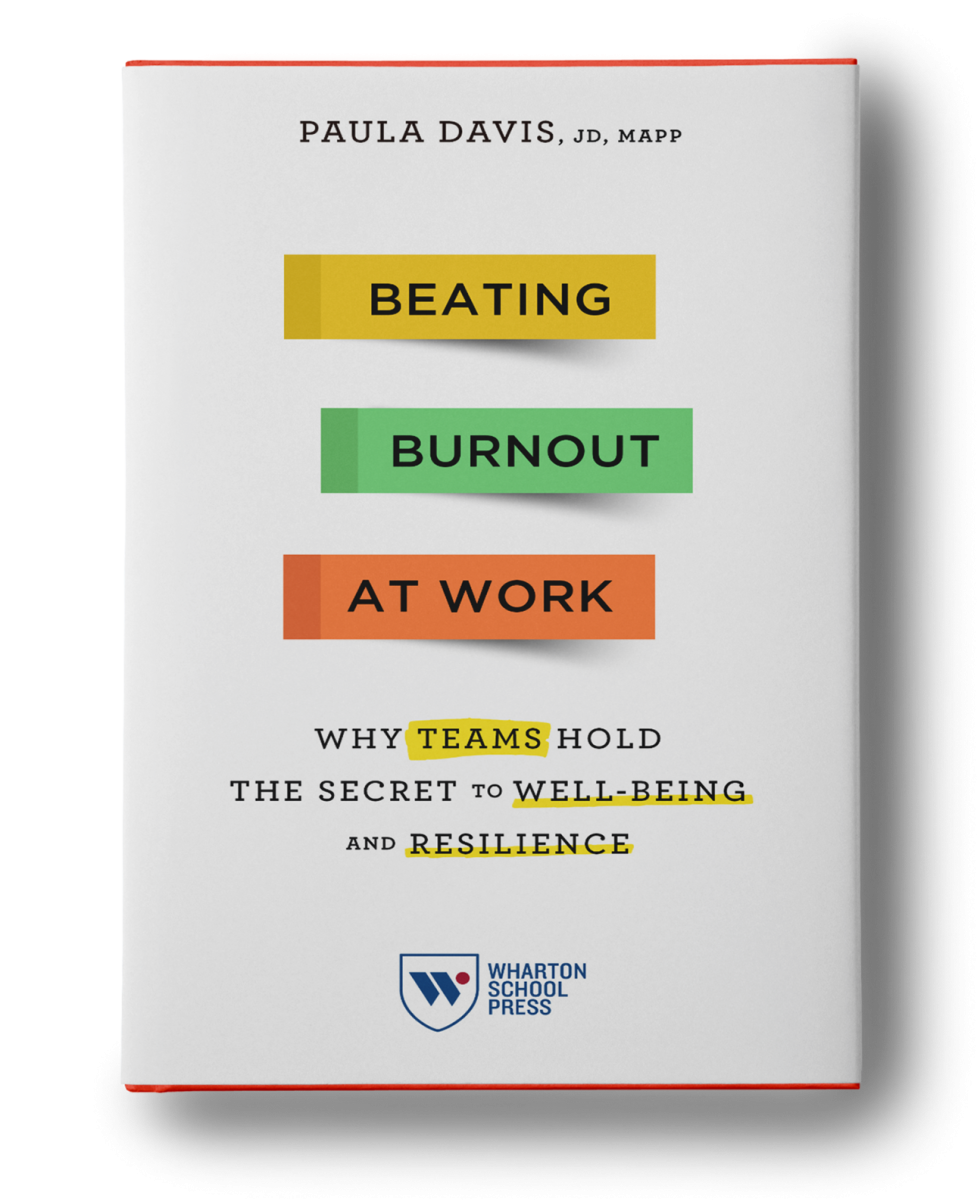
Please click here to pre-order my new book, Beating Burnout at Work: Why Teams Hold the Secret to Well-Being and Resilience now.  It will be available everywhere on March 16. 

study from the University of Southern California Marshall School of Business reports that, “feelings of stress may be lowered if they are experienced alongside another person feeling similar emotions.”  In short, actually labeling the emotion and saying something about it diffuses the emotion. To illustrate this point, I recently appeared on a national talk show with a panel of six other women.  We were all excited, yet nervous about the appearance.  As we were waiting offstage getting last minute make up and hair touch ups, one brave member of our group said, “Man, I’m nervous.”  You could immediately see the rest of the group let out a collective sigh of relief and it prompted a very healthy discussion about how we were feeling. In addition, Nicholas Christakis and James Fowler write that, “Social networks have clusters of happy and unhappy people within them that reach out to three degrees of separation…Each additional happy friend increases a person’s probability of being happy by about 9%.”  Research being done in the field of neuroscience also shows that emotions are contagious.  “Mirror neurons” in our brains literally catch another person’s mood, much like catching a cold. So, if you’re in a group of stressed out folks, say something about it! Reference Christakis, N.A., & Fowler, J. Social networks and happiness.  Retrieved on November 25, 2013, from http://edge.org/conversation/social-networks-and-happiness.]]>

the chronic state of being out of sync with one or more aspects of your life, and the result is a loss of energy, enthusiasm, and confidence.  Eventually, and as I experienced toward the end of my law career, your physical health and mental well-being will likely deteriorate. While burnout can occur in many life domains (parents, spouses, and caregivers all can experience burnout), much of the burnout research focuses on work.  Research by Drs. Michael P. Leiter and Christina Maslach points to six specific sources of burnout at work: Lack of Control.  Your sense of control over what you do is undermined or limited and you don’t have a lot of say in what’s going on.  One study measuring job demands and lack of control found that the one combination that was most detrimental to health and morale was high job demands in combination with low control.  Individuals in this category experienced much higher rates of coronary disease and depression than those in other categories (Karasek, R., et. al, 1981). Values Conflict.  There is a disconnect between your own core values and the core values of the organization.  Many companies flash their mission statements and values on websites and marketing materials, but few actually walk the talk.  If you want to learn more about values and categorize your own, please visit my website to find a free values worksheet. Insufficient Reward.  You feel taken for granted, not recognized, and/or undercompensated.  Many companies survived the Great Recession by demanding employees do more with less, and that often meant having one person do the work of two (or more).  While this may have been a strategy necessitated by the severity of the economic crisis, it’s unreasonable to expect this to work as a long-term strategy.  At my husband’s company, the CEO and other managers often send company- wide emails recognizing the efforts of employees.  It takes a few minutes to type an email, but the goodwill created will last far longer. Work Overload.  Your workload is too much, too complex, or too urgent.  When I was practicing law, I had a client who categorized the priority of his work for me as “nuclear,” “super-nuclear” and “catastrophic.”  I still don’t know what the difference is in the three designations, and I suspect he was so busy that even he didn’t really know – he just wanted me to take care of matters urgently.  The stress created by work overload is not something to be ignored.  According to the most recent Gallup survey on employee engagement, 50% of workers report being “not engaged” while another 20% report being “actively disengaged” (Sorenson & Garman, 2013). Unfairness.  You or others are treated unfairly, there is a culture of favoritism, and assignments and promotions are made in an arbitrary fashion and discussed behind closed doors.  One of the things that makes a company great, according to a recent Harvard Business Review article, is that employees are told what’s really going on.  Nothing shuts down morale more than whispering behind closed doors. Breakdown of Community.  You have to work with patronizing colleagues, there is no mechanism for conflict resolution, and feedback is non-existent.  One study found that the number of people saying they have no one with whom to discuss important issues has nearly tripled between 1985 and 2004 (McPherson, Smith-Lovin, & Brashears, 2006).  We spend so much time at work – building better relationships should be a main goal for all employees and managers. Our culture of burnout isn’t going to improve until these six sources of burnout at work are addressed.  What’s troubling is that you don’t need to have a serious mismatch in all six of these areas to be at risk – a mismatch in even one area puts you on the path toward burning out.  The time to start is now. ______________________________________________________________________________________________ Connect with Paula on Twitter, Facebook, and LinkedIn. ______________________________________________________________________________________________ References Freudenberger, H.J. (1974). Staff burnout. Journal of Social Issues, 30, 159-165. Karasek, R., et. al (1981). Job decision latitude, job demand, and cardiovascular disease: A prospective study of Swedish men.  American Journal of Public Health, 71, 694-705. Leiter, M.P., & Maslach, C. (2005). Banishing burnout: Six strategies for improving your relationship with work.  San Francisco, CA: Jossey-Bass.  See also, Maslach, C., & Leiter, M.P. (1997). The truth about burnout: How organizations cause personal stress and what to do about it.  San Francisco, CA: Jossey-Bass. McPherson, M., Smith-Lovin, L., & Brashears, M.E. (2006).  Social isolation in America: Changes in core discussion networks over two decades.  American Sociological Review, 71, 353-375. Sorenson, S., & Garman, K. (2013, June 11).  How to tackle U.S. employees’ stagnating engagement.  Retrieved on August 29, 2013, at http://businessjournal.gallup.com/content/162953/tackle-employees-stagnating-engagement.aspx.  ]]>

By Emilie Donals Lazenby

If you wake up often in the night, feel less than refreshed in the morning, have difficulty falling asleep initially or falling back asleep throughout the night, you may be willing to try just about anything that promises a good night of sleep. You’re not alone. Think a little lost sleep is no big deal?  Let me offer you a key piece of research that will open your eyes, as it were, to the dangers of too little sleep:     Feeling fatigued can impact performance levels as much as alcohol intoxication. To forge a new path towards healthier sleep and a healthier lifestyle, begin by assessing your own individual needs and habits. See how you respond to different amounts of sleep. Pay careful attention to your mood, energy and health after a poor night’s sleep versus a good one. Ask yourself, “How often do I get a good night’s sleep?” If the answer is “not often,” then you may need to change your sleep habits or consult a physician or sleep specialist. To pave the way for better sleep, experts at the National Sleep Foundation recommend that you and your family members follow these sleep tips: During the day: – Consume less or no caffeine, particularly late in the day. – Avoid alcohol and nicotine, especially close to bedtime. – Exercise, but not within three hours before bedtime. – Avoid naps, particularly in the late afternoon or evening. – If you know you are heading into a period of sleep deprivation, bank your sleep a few days ahead of time by tacking on at least an hour more of sleep each day. (Rupp et al, 2009). At night: – Establish a consistent bedtime routine and a regular sleep-wake schedule – begin an hour or more before the time you expect to fall asleep (take a bath, read a book, listen to soothing music or relaxation CD.) – Do not eat or drink too much within 2 hours of bedtime. – Create a sleep-promoting environment that is dark, cool, and comfortable. – Keep sleep stealers outside the bedroom —use your bedroom for sleep and sex ONLY (no last minute work projects on the computer, watching TV, or eating in bed). – Avoid distractions – Turn the alarm clock away from your line of sight and consider a bedside fan or white-noise machine to block out disturbing sounds. – Write out your to-do list for the day or week in advance and keep it on your nightstand for reassurance. Happy sleeping!   References Rupp TLWesensten NJBliese PDBalkin TJ (2009). Banking sleep: realization of benefits during subsequent sleep restriction and recovery. Division of Psychiatry and Neuroscience, Walter Reed Army Institute of Research. Sleep. 32, 311-21. Thomas, Maria, et al. (2000). Neural basis of alertness and cognitive performance impairments during sleepiness. I. Effects of 24 h of sleep deprivation on waking human regional brain activity, Journal of Sleep Research, vol. 9, 335±352.]]>

By Emilie Donals Lazenby

I love food. I love to shop for it, I love to prepare it, and above all, I love to eat it. Lately however, it seems this process is getting more and more confusing, particularly when it comes to food labels and what to buy. There is 100% organic, organic (95% or more of organic ingredients), natural, all natural, hormone free, cage-free, pasture raised, processed/unprocessed, grass-fed/grain-fed, farm-raised/wild caught, non-GMO, blah blah blah… Is anyone else confused, or is it just me? On top of that, we are bombarded by the latest and greatest diets promoting gluten-free, grain-free, dairy-free, high protein-low carb, vegetarian, vegan, etc. So by my calculations, if I followed the advice of all these diets, I would be left with… Water? Seeking clarity on this issue, I decided to contact four different experts who specialize in evaluating current diet trends and who provide research-based evidence on healthy eating. What were the findings, you ask? Unless you have food allergies or intolerances to certain foods, they all said, “Don’t diet.” Seriously?  Seriously. According to research scientists and Registered Dieticians, Dr. Jaleh Depahlevan and Dr. Sarah Rourke from the University of Denver and Clinical Registered Dieticians Kyle Miller and Chelsey Foster from the University of Colorado at Colorado Springs, eat a balance of real foods that work for your body, performance, and health. Okay so, what are real foods? Put simply, if the majority of the food you eat comes from a farm, and not a factory, you are on track. To help debunk some of the food labeling confusion and buy the foods that are going to give you the most bang for your buck, try these four strategies: 1.     Buy local if possible. Your best chances for getting the freshest foods are to contact your local farms or buy from farmers markets. Not only are you doing something great for you and your family’s health, but you are also supporting local farmers and small businesses! 2.     If you purchase your food from a grocery store, shop the perimeter, and do so on a full stomach. Keep in mind that ALL grocery stores are designed to entice you, and this happens a lot more easily on an empty stomach. The foods that sell best and bring in the most profits are not necessarily the ones that are best for your health. The perimeter of the grocery store contains all your real foods: meats, grains, produce, and dairy. Limit time in the middle aisles as these contain most of your processed foods, apart from frozen fruits and veggies. 3. Read food labels. People who read food labels are, on average, about 10 pounds thinner (Loureiro et al, 2012). Keep in mind that reading labels won’t make you thinner, but the decision you make based on what you read will. My rule of thumb is, if you can’t pronounce it, don’t eat it, or at least limit your consumption of it. Let’s look at one of the biggest food label fables of all, whole wheat bread. Real whole wheat bread should contain the following ingredients: 100% whole-wheat flour, water, honey, yeast, and salt. Instead, most bread sold in grocery stores have a paragraph of ingredients. See for yourself the next time you are shopping for “healthy” wheat bread. 4. Know yourself! Everyone is different, so take note of how you feel after eating different kinds of fruits/veggies, meats, dairy, grains, and even processed foods, then take note again 2-3 hours later. If they work for you, great! But if they don’t, find what does by paying special attention to your mood, focus, and energy levels after meals. Test it out for yourself! For best results, print at least three copies of our Daily Food and Energy Log and record your results here. After at least three days, notice the foods and drinks that give you the most benefit for your particular energy demands, and those that zap your energy. It doesn’t mean that you HAVE TO stop eating those foods, but be aware of the physical and mental side effects if you do choose to consume your “energy zappers,” my term for junk food. Remember, this is not about a diet. What works for one person may not work for you, so focus on how your body responds to various foods and stick with foods that improve mood, focus, and energy levels. Knowledge may not be enough to curb the urge to eat certain foods, but it may counter the subtleties of food marketing  and allow you to maneuver through the food jargon and health fads to find the strategies that work for you.  (Nestle, 2012). References Nestle, Marion. Why Calories Count: From Science to Politics. Berkeley: University of California Press. 2012. p. 304. Loureiro et al, The effects of nutritional labels on obesity. Agricultural Economics Volume 43, Issue 3, pages 333–342, May 2012]]>

CONTACT US
Let’s begin
Complete the form below to start a conversation about trainings, consulting, or leadership support for your organization.

Contact Form 2025 TM

  • This field is for validation purposes and should be left unchanged.
  • This site is protected by Cloudflare Turnstile and the Privacy Policy applies

Paula Davis is a burnout and leadership expert who helps organizations reduce burnout and build resilient, high-performing teams.
Stay in the loop

Newsletter Signup

Newsletter Signup

  • This field is for validation purposes and should be left unchanged.