The conversation about AI at work has become dominated by speed, efficiency, and productivity gains. Leaders are under pressure to move quickly, experiment publicly, and integrate AI into everyday workflows before they fall behind. But in the rush to adopt new technology, many organizations are overlooking one of the most important, foundational conditions for successful AI integration: psychological safety. In AI-enabled teams, employees must feel safe enough to ask questions, challenge outputs, admit uncertainty, experiment without fear of embarrassment, and speak up when something feels ethically, strategically, or operationally wrong. Without that foundation of trust, even the most sophisticated AI strategy will stall—not because the technology failed, but because people stopped engaging honestly with it.
AI, Psychological Safety, & Junior Talent Development
Psychological safety is the belief that you can be yourself, take good risks, ask questions, share partially formed ideas, raise problems, and respectfully disagree within your work teams without the worry of being embarrassed, singled out, or penalized. When employees feel psychologically safe, they feel comfortable speaking up and are far more likely to identify serious errors or problems earlier. They are also more likely to think creatively, share innovative ideas, and share their expertise, all of which matter in the context of work generally and AI integration specifically.
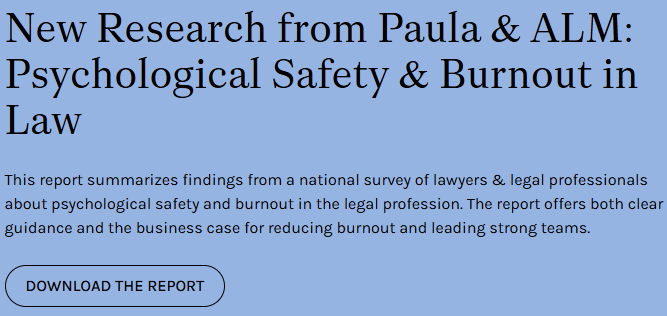
I recently had the opportunity to measure psychological safety in the legal profession. Approximately half of the nearly 900 survey respondents felt like their work efforts were not deliberately undermined, their unique skills and talents were valued at work, and they were able to bring up problems and tough issues at work. However, more than 40% of respondents found it difficult to ask for help, almost one-third reported that mistakes were often held against them, and nearly 20% said they felt rejected for being different.
The “psychologically unsafe” group responded “yes” to these statements:
** It is difficult to ask others for help;
** If I make a mistake, it is often held against me; and
** I am sometimes rejected for being different.
This “psychologically unsafe” group was almost 70% female and associates, and more than one-third were 25-34 years old. Interestingly, a similar finding emerged in a study about burnout and psychological safety in medical school. That study found that female medical students perceived medical school as less psychologically safe than their male counterparts.
The psychologically unsafe group in law reported lack of support for personal well-being/work-life balance, lack of sponsorship/mentorship, and dysfunctional firm culture more regularly compared to the general group in the additional question section of the survey.
Junior talent development is quickly becoming one of the hottest issues in law firms, across professional services, and in the workplace generally. How is junior talent supposed to gain judgment, learn through repetition, experiment with AI and changing workflows, and build new capabilities if a solid foundation of psychological safety isn’t present?
AI Integration & Teaming Challenges
AI integration doesn’t just surface technology issues – it also uncovers team dynamics issues. As organizations rapidly integrate AI at work, leaders are uncovering the impact of AI tools on team dynamics; specifically, team performance appears to be declining.
One of the reasons why teaming challenges arise is trust because AI can change the dynamic within a team and introduce trust ambiguity. When the humans on teams make a mistake, other humans can ask questions to understand what happened, give context, and then figure out ways to prevent the mistake from happening again. This process of mutual learning, which strengthens teams, isn’t there with AI tools. Humans can’t challenge AI in the same way, which makes it hard for team members to understand what caused the error or how to prevent it from happening again.
AI doesn’t pick up on team contextual cues, adjust its communication style to match people on the team, or engage in informal relationship building with other team members. As a result, there can be a cost to team dynamics when an AI team member operates according to fundamentally different team rules.
4 Steps to Increase Psychological Safety on Your Work Teams
One way to help is to apply psychological safety principles to AI integration. Dr. Amy Edmondson and her colleagues recommend these steps:
- Reframe AI as a learning process, not just an execution process. This means that it’s important to position AI deployment as ongoing experimentation with hands-on learning.
- Model fallibility and curiosity. One of the biggest ways leaders create psychological safety is by acknowledging their own mistakes. Leaders can share their own mistakes with AI and what they learned.
- Create intelligent failure protocols. There are different types of failures. Did your team experience an “intelligent failure” or a “basic failure?” Intelligent failures happen when you’re testing new AI tools in new ways where the risks are low, and mistakes should be celebrated as learning opportunities. Conversely, basic failures are mistakes that occur where limitations are already known and a basic process was missed.
- Emphasize human connection. As AI handles more routine tasks, what’s left is the more complex and interdependent work for teams. Leaders need to create space to discuss AI integration challenges. Leaders also need to be mindful of the importance of continued human-to-human interaction. One study found that 90% of workers see AI as a co-worker, 67% trust AI more than their colleagues, 64% say they have a better relationship with AI than with their human teammates, and 54% say AI is more empathetic. Team members need to also foster those same skills (trust, empathy, strong relationships) with each other.
As organizations race to build AI capability, the companies that will thrive are not necessarily the ones with the most advanced tools—they are the ones that create environments where people feel safe enough to learn, adapt, question, and collaborate alongside those tools. Psychological safety is not a “soft skill” or cultural nice-to-have. In an AI-enabled workplace, it is the infrastructure that allows innovation, trust, and human judgment to scale together.
For more information and support visit our On-Demand Resource Center.